Showing posts with label linkedin. Show all posts

Tuesday, March 24, 2015

Kevin O'Leary: 10 Secrets to Being The Best Boss You Can Be

Now, I know what you are thinking. Why is Kevin O'Leary giving advice on how to be a good boss?! There's no way he treats his employees with respect! Well, just because he is tough in the Tank doesn't mean he is a bad boss. Check out his latest LinkedIn Influencer article:

blog shark tank kevin o'leary boss
Over the years, I've worked for others and I've worked for myself. Through trial and error, I've figured out a few key character traits that helped hone my leadership skills. Directness, transparency, and decisiveness are three essential traits of a good boss. It’s also important to remember the rules outlined below.

1. Employees are not your friends. Even if you like them, even if you hired them because they are your friends, while they are working for you they are not your friends. They are your employees. The problem with socializing with your employees is that it makes it hard to be objective about their performance, and harder still to crack down on them if they’re under performing.

2. Maintain a clear line of command. In most of my endeavors, I've had a partner, and we've helmed our companies side by side. But I weigh in on issues that fall outside the realm of my command only when completely necessary. Employees always knew which problem to take to Michael Perik and which to take to me. Overlap of authority can get confusing, muck up productivity, and cause unnecessary delays, if not out-and-out grief.

3. Be accessible. You’re not building a fiefdom—you’re building a company. Don’t alienate, isolate, or separate yourself from your partners and top earners. Don’t put them on hold, don’t fail to return their calls, and don’t make them feel like they cannot approach you. I've seen this phenomenon firsthand. It’s toxic, and it’s usually the product of fear or the inability to cope during troubled times. If your first instinct is to bury your head, you are not a leader.

4. Delegate, delegate, delegate. You cannot—nor should you—do everything. CEO's who think that they should weight in on every single aspect of their company get too bogged down in the details, much to the detriment of the overall health of the company. If a ship’s captain is overseeing the catering, he’s going to hit an iceberg.

5. Don’t procrastinate. When an employee is problematic, you must act. Now. Do it right. Do it by the book. But do it.

6. Never pass the buck. Blame stops with you. It always stops with you. Even if you think you had nothing to do with the decision that got your company into trouble in the first place, you’re wrong. You likely had something to do with hiring the person who did screw up. Take immediate responsibility, do what you can to fix the problem, and then whack the knucklehead who couldn't keep pace. If your name is on the product, business, or marquee, that’s especially important.

7. You’re not their parent. Employees will only bring their drama to work if you let them. If you don’t want to be treated like a parent, don’t act like one. If employees are having squabbles, let them figure it out among themselves. I also try to steer clear of giving personal advice. My employees problems are their problems to solve. And it’s up to them not to bring those problems to work. By the way, if one of your employees is suffering from a genuine issue—addiction, depression, that kind of thing—don’t suggest they get help, insist upon it.

The 10 Secrets to Being the Best Boss You Can Be
8. Life’s not fair. Some people will simply make more money than others in the same job. Some people will work harder. Some will get higher sales. You will trust one over the other to get the job done. You will likely have favorites. That’s life. If someone complains about it, tell him or her to get over it.

9. The boss doesn't always make the most money. Find stars and pay them well. If you want to attract those stars, you’ll have to lure them with dollars. Remember that money’s the great motivator, and if it means you take a hit financially, take it. Talent will always bring in more money for the company, and that has got to be your number one priority always. Which leads me to…

10. The company comes first. This is the most important tenet. Have a singleness of purpose—the health and welfare of the company—keeps things clean and clear. Employees never question your priorities, nor do they have to guess at their goals.


Monday, January 26, 2015

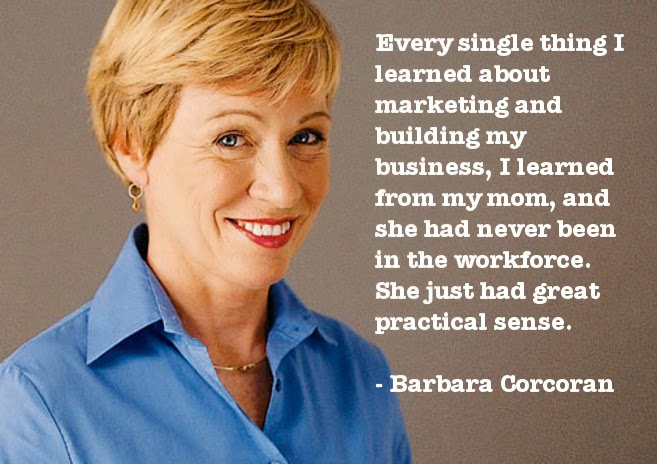
Barbara Corcoran: Here's How To Reinvent Yourself

Here is a great article by Barbara Corcoran on how to reinvent yourself. You can find the original article here.


barbara corcoran blog shark tankThe start of the New Year is a great time for a fresh start. But change is tough.

When I sold my real estate business, which I had built for 30 years, I was unprepared for the personal challenges I’d need to overcome. Reinventing myself in a new career was so much harder than I expected. If you've been dreaming about totally changing your career, here are a few things that will help you along the way.

1. There’s no such thing as a total reinvention.

The best you can do is “repackage” yourself!

When I sold my real estate business, I needed to figure out who I wanted to be in my next chapter, so I sat down and wrote a list of every job I ever held and what I liked and disliked about each.

There were 23 different jobs on my list and to my surprise, I found I liked the same two things--I love an audience and I’m really good at marketing! So my list of potential new careers that could build on my strengths was a short one. I decided I was either going to start a PR company or an advertising firm or I was going to make myself a talent on TV. I took a shot at TV because I knew it would give me my biggest audience and I would have the chance to market myself instead of a whiny client. You’ll have a much greater chance at success and happiness in your new career if you know what you like and what you’re really good at and if you can manage do a lot more of it. Remember, you can repackage yourself but you can’t change your wiring.

2. Expect to be lonely. 

When I sold my business, a major piece of my identity went with it. I missed my 1,000 adoring brokers and my management team that had become my family. I was no longer part of a work community— of course I missed the parties and good times, but I even missed the endless stream of emails that used to be the bane of my existence. In my search for connecting with a new community of people, I plugged into the social media world and found that Twitter and Facebook made me friends with a whole range of new people and they became my stand-in community. I built myself a circle of support.

barbara corcoran marketing shark tank3. You have to reinvent yourself in stages.

Successful reinvention can’t happen overnight. So instead of trying to reach my end goal as a business expert on TV, I built my new persona in small steps. I started as an occasional on-air guest on local TV, then got paid as a real estate contributor on morning talk shows, and finally landed as a Shark/Investor on ABC as a business expert. Landing your first gig in your new space will serve as confirmation that you’re on the right track and will increase your confidence so you’re able to reach your end goal.

4. There’s no such thing as part-time. 

Even if you’re a pro at the top of your game in your industry, once you switch to a different field you’re starting from scratch. Building a successful new you takes the same long hours as your first career and you’ll still have to give it 150% of your time. At first, I thought I could give half my energy to reinventing myself and the other half to having fun, but it didn't work out that way. I had to work just as hard at building my second career as I had my first and this time I didn't have the advantage of youth.

Change is tough and you can always come up with 100 reasons not to do something or quit in the process, but reaching a goal that you bravely fought and won, is invigorating and a worthy reason for doing it.

To see this article's sponsor, click here.

Tuesday, December 16, 2014

Kevin O'Leary: New Year's Resolutions

With the New Year just around the corner, many of us are already wondering what 2015 has in store for us. While it is certainly important to come up with your own New Year's Resolutions, Mr. Wonderful has been gracious enough to share (on LinkedIn) some of his advice for gaining more financial freedom in the upcoming year. Enjoy!

kevin o'leary new year
The New Year is almost here and you know what that means. A brand new set of financial challenges. In this economy, those challenges can seem bewildering. Thankfully, I can help you navigate those perilous waters so that you and your family hold on to as much as possible of that most precious of commodities: Money! Here are three New Year’s resolutions that will move you and your family further along the path to financial freedom.

1. Summarize All Your Spending

You already know how important it is to set aside some of your income - even if you start small - to invest and put to work towards building your wealth. But it's also easy to get tempted to spend more than you should. That's why you need discipline - and a great way to build discipline it is to prepare a monthly summary of all of your spending.

I’m not talking about your monthly bank statement (though you should pay attention to that, too). I want you to track all your spending so that you can better evaluate your decisions about your cash. Plenty of tools can help you, from a pen and paper to spreadsheets or smartphone apps.

Once you start seeing these lists of where your precious money is going, you'll be amazed at how quickly you start thinking twice before spending what you should be investing.

2. Get More Yield from Your Assets

My mother taught me about the importance of limiting risk when it comes to money. One of the ways I do that is by prioritizing reliable, income-producing investments - the kind that pay regular dividends, interest or distributions. (Your financial adviser can tell you more about the pros and cons).

One of the great things about this strategy is that you don't need to worry as much about day-to-day stock price movements. But the best part is the feeling of knowing that your investments are regularly generating cash.

3. Make Sure Your Kids Know How to Manage Their Money

There's nothing like family to help motivate people when it comes to being smart with money. It makes sense - you're more driven to save and invest when you know that your savings will help your kids and grandkids – not just yourself. And you'll be more careful about big risks when you know that a bad decision can affect your family.

So, just as my mother taught me about money when I was young, I have done the same for my kids.

If you haven't done the same yet, get started this year. It's easier than you think - start by talking about money in general, so it's not a taboo subject. Have some conversations about the importance of saving over the long term. We all feel a responsibility to our families and there’s no reason that shouldn't include financial literacy.

Get Started

These three New Year’s resolutions are simple, but powerful. If you follow them, you’ll be surprised at how much you save for yourself and your family. They’re also easy to follow, so you have no excuse not to take these steps. You’ll thank me later.

[None of this content should be construed as investment advice, especially as they relate to any financial products I may represent. Investors should speak with their financial advisers for any investment advice and to discuss the risks of investing to any financial product. This represents my personal opinions and should be enjoyed as such.]

Monday, November 24, 2014

Robert Herjavec: The Road Not Taken

Here is an article written by Robert Herjavec for LinkedIn a few days ago about hustling. It is short and to-the-point, yet very inspiring.

The Road Not Taken: The Moment I Realized I Needed to be the Supplier, Not the Seller

By: Robert Herjavec

The story of my family immigrating to Canada when I was eight is relatively well known. A quick Google search turns up a number of results about how I’m the "son of an immigrant factory worker” as they say on "Shark Tank." What many people don’t know, is that my road to success was not always uphill.

After graduating from college, I began working in television production. I was one of the youngest producers to cover an Olympic Games and thought perhaps I could make my mark in TV. After the Sarajevo Olympics, I returned to Toronto and auditioned for acting gigs while waiting tables. I quickly realized this wasn’t the life that was going to provide for my family. My parents had shown me what it was like to sacrifice absolutely everything — money, family, security — for the opportunity of a better life. I knew I could do more to deliver for them.

I had a knack for talking to people and an insatiable drive to achieve — so sales made sense. Like so many young salesmen, I was a bit of a hustler. I was the go-getter, the yes-man, the whatever-it takes-to-make-a-deal guy. I was 150 percent committed to getting the deal and my boss and customers knew it. Problem was—I was the man for someone else’s bottom line.

robert herjavec road not takenA turning point in my career came when Warren Avis, founder of Avis Rental Car, and my boss at the time, took me aside and told me I was working way too hard to achieve my goals. “You’re putting so much pressure on yourself. You’re never going to scale that way,” he said.

He brought me to the window in our office and we stared down at the hot dog vendor selling on the edge of the parking lot.

“You’re the hot dog vendor,” he said. “You’re pushing your product, you’re doing all the work and you’re sweating it to make a living. You need to be the guy supplying the dogs to all the vendors if you ever want to scale.”

His words took me by surprise, I was doing it wrong. I had huge dreams — and I mean HUGE — but I had the wrong approach.

That day was a turning point in my professional career. I realized that I couldn't do it alone. I needed to leverage the resources around me and dedicate myself to an opportunity that had the potential to scale.

When I started Herjavec Group in 2003 with George Frempong and Sean Higgins, we were three guys in an office with big dreams of dominating the information security industry in Canada. Over the past 11 years we have scaled to $150 million in annual sales revenue and more than 200 team members. Today we are one of the largest independently-owned information security firms in North America, and recently expanded into the U.S. with presence in NYC, Dallas and Los Angeles. We have the ability to serve customers globally and plan to formally establish a presence in Europe in early 2015. That type of success doesn’t come from pushing hot dogs from a stand. We had to become the service provider — the go-to supplier — the trusted advisor to our enterprise customers.

When you’re deciding what path to choose — think about what’s important to you and to your family.

What will it take to get there? How can you scale? Don’t set a goal to build a $100 million business, build ten $10 million businesses.

Break up your goals so you can almost grasp them.

Now get out there and hustle.

You can read the original article here.

Sunday, October 19, 2014

Kevin O'Leary: 3 Money Mistakes You Must Fix to Get Rich

In a previous post, I shared a list of my top five Influencers on LinkedIn. It took some time, but LinkedIn finally extended the Influencer title to all of the Sharks, at least to those who have an active presence on LinkedIn. Here is an article written by Kevin O'Leary just a couple of days ago which I thought was worth sharing here on Blog Shark Tank. I think the topic is critical especially for millennials and the younger generation, and is blunt and to the point, just like everything that comes out of Mr. Wonderful's mouth. So here it is:

3 Money Mistakes You Must Fix to Get Rich 

By: Kevin O'Leary


I get a lot of questions about how to get rich, and I always give the same answer.

Don’t spend too much. Mostly save. Always invest.

Seems simple enough, right? Yet so many people do the exact opposite—invest poorly, spend way too much, save almost nothing, and remain willfully ignorant about their finances.


Why? Because they don’t understand their relationship to money.

The first step in changing money habits is taking a cold hard look at your financial input and output. Here’s what you need to do: boil your money matters down to one simple number by adding up all your earnings and subtracting all your expenditures over three months. I call this your 90-day number.

Once you write that 90-day number down you’ll be faced with one of two truths.

Your number is positive. Congratulations, you’re one of the few people taking in more money than you spend!

Your number is in the negatives, and like the majority of men and women, you spend more than you make.

The good news is that no matter what your 90-day number teaches you about your relationship with money, there’s always room to improve. I’m going to help you do exactly that by pointing out 3 money mistakes everybody makes at some point in their lives, and teaching you how to fix them.

Money Mistake #1: You’re drowning in credit debt.

The Fix: READ THE FINE PRINT

Spending too much is a disease, and credit card debt is a cancer. The first time you get a credit card bill and don’t pay off the full balance, you’ve let the first financial cancer cell into your life.

Next time you get a credit card bill in the mail, put your glasses on and take a good, hard look at the fine print.

Credit card companies are required by law to tell you how many years it will take you to pay off your balance if you pay the minimum each month. In most instances, this number is a monstrous thing to behold.

With typical compound interest rates averaging around 16%, this black hole of debt keeps growing, and growing, and growing.

Once you take a look at the fine print, you MUST start dedicating every spare penny you have to paying off your credit. If you want to get rich, you need to eliminate your debt first.

Money Mistake #2: Spending makes you happy

The Fix: GET A HANDLE ON EMOTIONAL SPENDING

Most men and women who spend too much do so because it feels good, temporarily. But as I always say, mixing money with emotions is a toxic combination.

Don’t go shopping to change your mood. It might make you feel better in the short term, but I promise: the long-term fulfillment of saving and growing your money far outweighs the temporary satisfaction of retail therapy.

Recognize when you’re about to spend with your emotions, and go for a walk, cook, or read instead. Do anything; just don’t head for the mall!

Money Mistake #3: Frugality isn’t fun

The Fix: CREATE A “FUN MONEY” FUND

Many people who commit themselves 100% to eliminating debt and saving money find that a certain joylessness creeps in after a while. The same thing happens to dieters who deprive themselves of all their favorite foods for months, and then cave to late-night binges.

That’s not a way to live, and that’s not what I advocate. Austerity, yes; deprivation, no.

The key is to include spending on fun things in your budget. Set aside a manageable percentage every week in a fund that will let you splurge with cash. Go out for lunch, get your hair done, or use your fun money to go on a vacation—do whatever you want, as long as you pay for it outright. This way you can enjoy your splurges without feeling guilty!

You can read the original article here.